

Enterprise Software Development
Internal systems that replace spreadsheets and manual handoffs.
In most larger companies, a surprising amount of work still runs on spreadsheets, shared inboxes and someone re-typing data from one system into another. We build the internal software that removes those steps: approval workflows, ERP and CRM modules, reporting and integrations between the systems you already own.
We're used to working inside enterprise constraints. That means single sign-on, audit logs, role-based access, change management and IT security reviews. We work in .NET, Node.js and Java-friendly stacks on Azure or AWS, and plan rollouts so operations aren't disrupted.
What’s included
Pick the parts you need. Most projects use all of them.
- 01
Custom ERP & CRM modules
Modules for the parts of your business that packaged ERP and CRM software doesn't fit.
- 02
Workflow & approvals
Multi-step approvals with SLAs, escalations and a full audit history.
- 03
System integration
Connecting SAP, Salesforce, Dynamics, legacy databases and file drops into one flow of data.
- 04
Reporting & BI
Data pipelines and dashboards so managers stop asking for the same Excel report every week.
- 05
Legacy modernization
Moving older systems to supported platforms in stages, with data migrated and verified.
- 06
Security & compliance
SSO, role-based access, encryption and logging that will pass your IT security review.
What you walk away with
- Process mapping and a solution architecture document
- Enterprise application with SSO and role-based access
- Integrations with your existing systems
- Data migration plan, scripts and verification
- Training material, rollout plan and support SLA
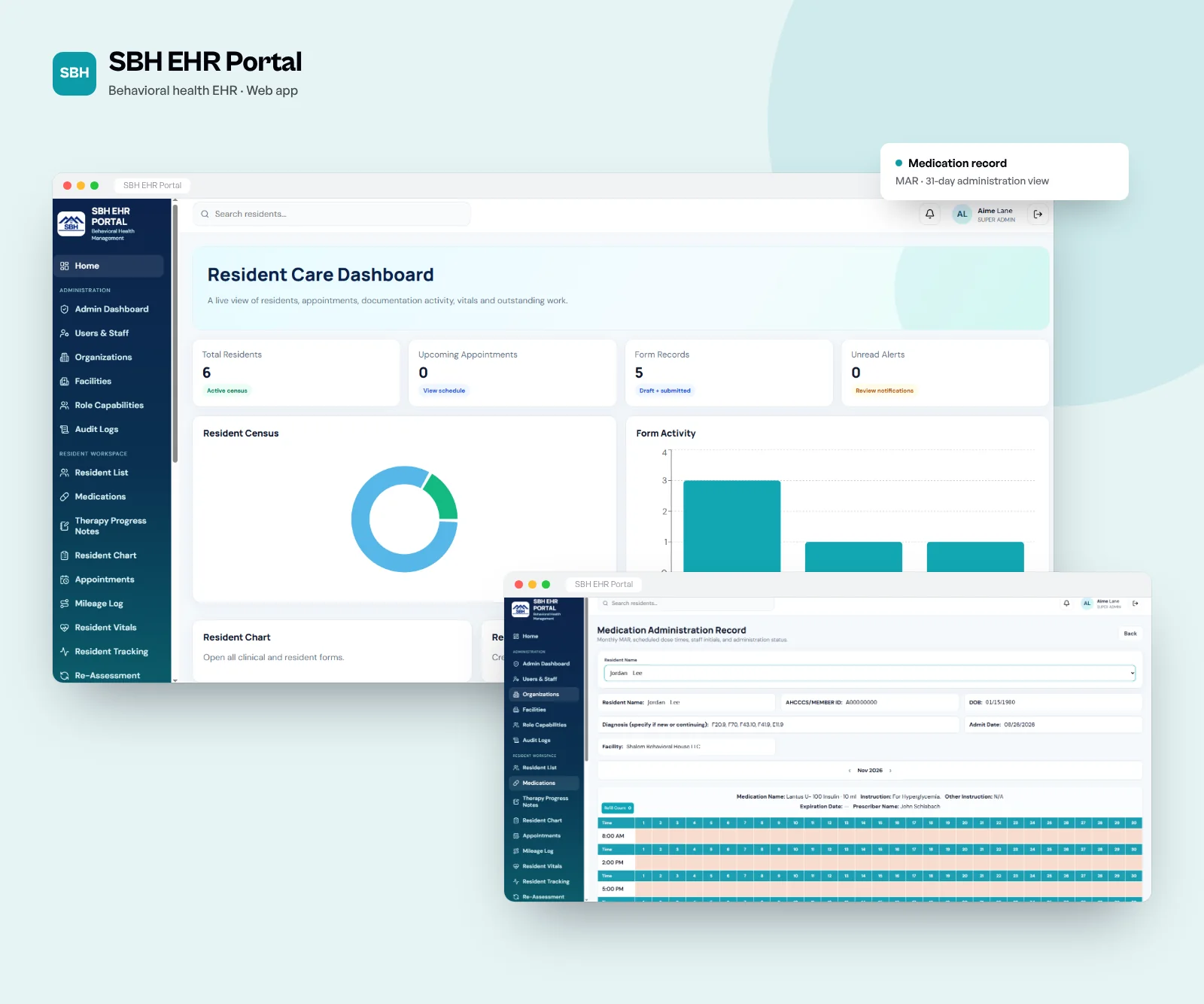
SBH EHR Portal, SBH, behavioral health
Tools we use
We choose per project. These come up most often for enterprise software work.
12345678910111213How a project runs
Five stages, two-week sprints and a demo at the end of every one.
Recent projects
Enterprise Software: common questions
How much does enterprise software development cost?
Enterprise projects vary widely. A single workflow tool or integration might be $40k-$100k. A larger platform that replaces several systems can run well beyond $250k. We usually begin with a paid discovery phase that ends in a fixed-price proposal.
Can you work with our internal IT team?
Yes, and we prefer to. We follow your security policies, coding standards and change process, and we hand over documentation so your team can run the system afterwards.
Do you support single sign-on?
Yes. We integrate with Azure AD (Entra ID), Okta, Google Workspace and other SAML or OpenID Connect providers.
How do you avoid disrupting daily operations?
We roll out in phases, run old and new systems side by side where it makes sense, and migrate data with checks at every step. Go-lives are planned with your operations team.
Can you modernize our legacy system?
Yes. We start with an assessment of the current system and then replace it piece by piece, keeping it running until each part has been moved and verified.